‘He restores my soul.’ Psalm 23:3 NKJV
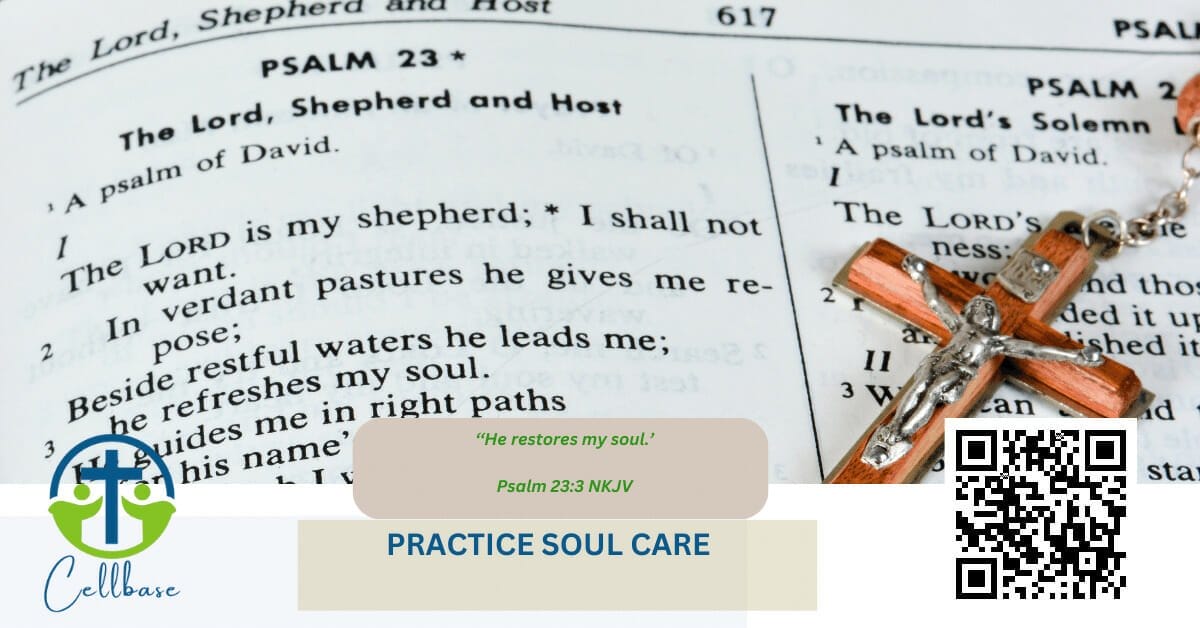
David said, ‘The Lord is my shepherd; I shall not want. He makes me to lie down in green pastures; He leads me beside the still waters. He restores my soul’ (vv. 1-3 NKJV). Today car engines are computerised. A light on your dashboard will let you know something’s wrong and that it’s time for a check-up. Your soul will do that too. But you’ve got to pay attention to the signals! Don’t wait until you have a spiritual, moral, emotional or relational breakdown before you stop and pay attention. When your soul’s thirst is not quenched and its needs are not met, it will seek relief some other way, often a way that will hurt you. You must know when to say ‘when’.
Most of us don’t take breaks that enable us to ‘restore our souls’. We’re ensnared by guilt, as if stopping would somehow be irresponsible. Or we fear losing ground because we took a minute for ourselves. One of the hardest things in life to achieve is not success, but a sense of balance. So in all your goal-setting and ‘go-getting’, don’t forget your soul. Even God rested (see Genesis 2:2). And if He did, then you need to also.
The power of rest is that it allows you to enjoy the journey of life and not just the destination. Indeed, if you don’t learn to walk in the park by choice, you may end up in the hospital by necessity. When God ‘makes you lie down in green pastures’, enjoy them. When He ‘leads you beside the still waters’, it’s to refresh and restore you. So practise soul care!
David or King David
King David is one of the most prominent figures in the Bible and is regarded as one of the greatest kings in the history of ancient Israel. He is primarily known for his role as the second king of Israel, succeeding Saul. David’s life and reign are extensively documented in the Hebrew Bible, particularly in the books of Samuel.
According to biblical accounts, David was born in Bethlehem in approximately 1040 BCE and grew up as a shepherd. He gained recognition when he bravely defeated the Philistine giant Goliath with a slingshot and a stone. This victory earned him the favor of King Saul and catapulted him into the public eye.
Following Saul’s decline and death, David was anointed as king by the prophet Samuel. He established Jerusalem as the capital of Israel and built it into a powerful city. Under his rule, Israel experienced a period of prosperity and military success. David is also credited with expanding the territory of Israel and establishing a centralized government.
David’s reign was not without challenges and controversies. He faced internal conflicts, family strife, and external threats. Despite his successes, he made some grave mistakes, including an affair with Bathsheba, the wife of one of his soldiers, and the subsequent murder of her husband. However, he showed remorse and sought forgiveness from God.
David is revered for his musical talents and poetic skills. Many of the Psalms in the Bible are attributed to him, expressing a range of emotions, from praise and worship to deep sorrow and repentance. These Psalms continue to be cherished by believers and have had a profound impact on religious worship and spiritual reflection.
David’s legacy extends beyond his reign. He is regarded as the ancestor of Jesus Christ in both biblical and historical accounts. The Messiah is often referred to as the “Son of David,” emphasizing the messianic lineage that traces back to David’s royal line.
In summary, King David was a shepherd, warrior, poet, and the second king of Israel. His life and reign are celebrated for his military triumphs, the establishment of Jerusalem as the capital, and his contribution to the Psalms. Despite his flaws, David is remembered as a key figure in biblical history and his lineage plays a significant role in Christian theology.
Psalms
The Book of Psalms, also known as the Psalter, is a collection of religious poetry and hymns found in the Hebrew Bible or the Old Testament. It consists of 150 individual psalms, making it the largest book in the Bible in terms of the number of chapters.
The Psalms cover a wide range of themes and emotions, including praise, thanksgiving, lament, confession, and wisdom. They are attributed to various authors, with King David being credited with the majority. Other authors mentioned include Asaph, the sons of Korah, Solomon, and several anonymous contributors.
The Book of Psalms is located in the Ketuvim, which is the third section of the Hebrew Bible. In the Christian Bible, the Psalms are included in the Old Testament and can be found between the books of Job and Proverbs.
Each psalm is an independent composition, and they are often used in worship and devotional practices by both Jews and Christians. The Psalms are known for their poetic beauty, rich imagery, and their ability to resonate with the human experience.
Numerous translations and versions of the Bible are available, and the Psalms can be found in all of them. They are typically labeled with numbers, making it easy to locate specific psalms. Additionally, many prayer books and hymnals include selections or adaptations of the Psalms for use in liturgical and personal worship.